
Sales data for multi-site retail

Every till in the estate, reconciled by morning.

epostle collects last night’s sales from every store, checks them against what the tills themselves report, and turns them into reporting your team can act on and ledger data your finance system can consume. One estate, one set of numbers, no spreadsheets in between.

Works with your existing EPOS · one instance per client · hosted and maintained

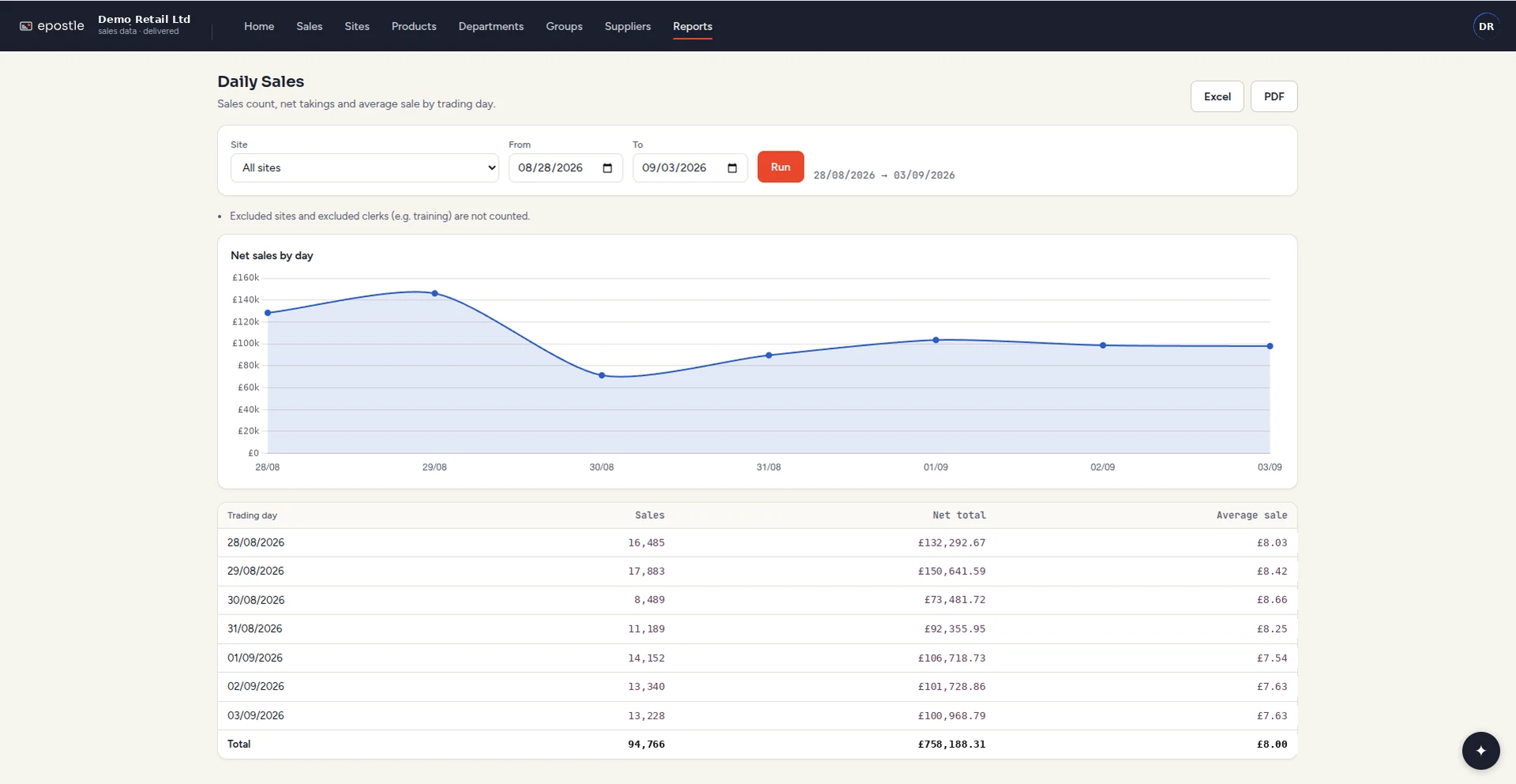
The epostle Daily Sales report: net sales charted by trading day above a table of sales count, net total and average sale for each day, with an estate total.
Daily Sales across an estate — every figure drills down to the transaction behind it. Client name and values anonymised.

What happens every night

Four stages, unattended. The third is the one that sets epostle apart: it does not simply trust what it imported.

  1. STAGE 1

    Collect

    Sales are pulled from the EPOS system on a schedule, site by site, at a pace the vendor’s API is comfortable with. Interrupted nights are picked up automatically.

  2. STAGE 2

    Normalise

    Every transaction becomes one consistent model — products, departments, tenders, discounts, channels — with the original payload kept in full.

  3. STAGE 3

    Reconcile

    Each site and trading day is checked against the till’s own end-of-day totals. Anything that disagrees is raised as an exception, not averaged away.

  4. STAGE 4

    Deliver

    Verified data reaches the reporting suite and, where you need it, a database you own for finance and stock systems to read.

The source

It starts at the till, not at a spreadsheet.

Every sale your staff ring up is collected from the EPOS system itself — items, tenders, discounts, refunds and voids — at a pace the vendor's API is comfortable with. Nobody exports anything, and nobody keys anything in twice.

The original payload for every transaction is kept exactly as the till sent it, so any figure on any report can be traced back to what actually happened at the counter.

A shop assistant serving at a touchscreen till, opening the cash drawer.

What you get

Estate reporting

Trading performance across every site, in one place.

  • Daily sales and site league tables, with change against the previous period
  • Product, department and PLU-group analysis
  • Payment and order-channel mix
  • Drill from any figure down to the individual transaction
  • Export anything to Excel or PDF

Cash and loss prevention

The questions a till system will not answer on its own.

  • Cash declared over and short, by site and over time
  • Sites with a pattern of discrepancies, not just one bad night
  • Refunds, voids and manual drawer opens
  • Discount usage by till key — promotional and staff

Margin and suppliers

Cost-aware analysis the EPOS cannot produce alone.

  • Supplier sales summaries with cost and margin, net of VAT
  • Your own product codes alongside the EPOS PLU
  • Supplier lists and product mapping imported from your files
  • Best and poorest margin lines by department, group or supplier

Ask epostle

Questions in plain language, answered from your own data.

  • “Which sites were short on cash this week?”
  • “How did that range perform against last month?”
  • Read-only, and only within the asker’s own permissions
  • Every answer links back to the underlying records

Ledger delivery

Reconciled sales delivered to the systems that need them.

  • Line-level ledger rows written to a database you own
  • Column names and mapping configured to your schema
  • Re-imported transactions are replaced, never duplicated
  • Further targets added as adapters

Operational confidence

You will know when something has not arrived.

  • Every import and reconciliation run logged and visible
  • A site reporting takings with no imported sales raises an alert
  • Missed days re-collected automatically
  • Full audit trail, with the original EPOS payloads retained

Proven at estate scale

Figures from a live epostle deployment across a national specialist retail estate.

250+
stores collected nightly
≈1M
transactions imported per month
7,680
site-days reconciled in a month
£0.00
variance against till totals

What it means for the business

Numbers you can defend

Every site-day is checked against the till’s own totals before it reaches a report. When head office and store disagree, the difference is already identified rather than argued about.

Head-office time back

Collection, checking and consolidation happen overnight without anyone opening a spreadsheet. Your team works the exceptions instead of assembling the data.

Losses become visible

Cash shortfalls, refund patterns, void volumes and staff discount use are reported per site and over time, so a persistent problem separates itself from a one-off.

Buying decisions with margin attached

Sales are matched to cost and supplier, so range and supplier reviews start from contribution rather than turnover.

Finance systems fed automatically

Reconciled sales arrive in your own database on the same schedule, removing a manual hand-off and the errors that come with it.

Answers without a queue

Anyone with access can ask a question in plain language and get an answer from live data, within the permissions their role already carries.

See it against your own estate

We will walk through epostle with data shaped like yours, and show what last night would have looked like.

Book a demo